
Baruch Spinoza Was an Atheist
© Paulo Bittencourt
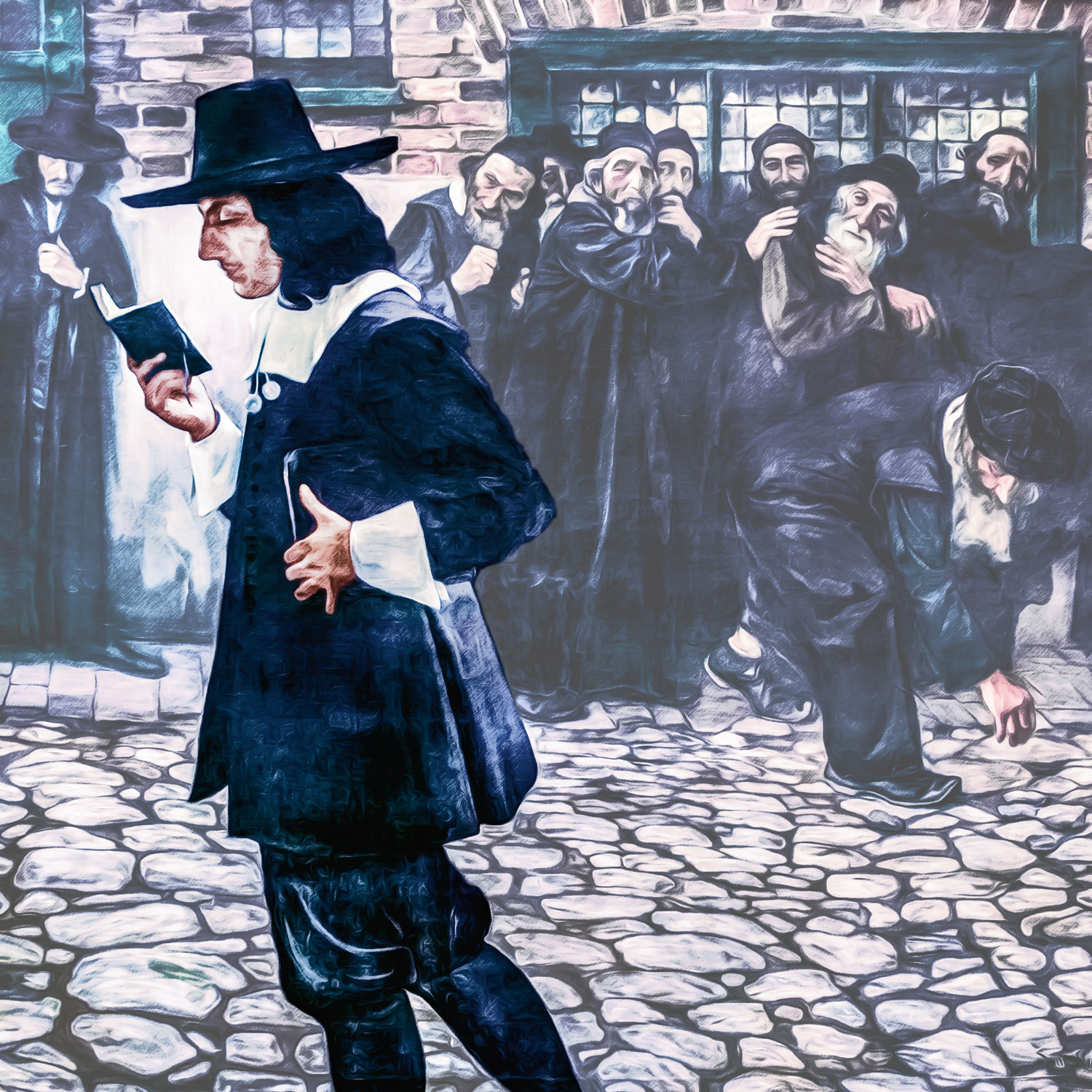
My favorite philosopher? Bento de Espinosa, internationally known as Baruch Spinoza.
Son of Jews who fled the Portuguese Inquisition (followers of the religion of the love of Jesus forced Jews to convert [those who didn’t convert were killed]), Spinoza was born in Amsterdam, Netherlands, in 1632. He studied to become a rabbi, but was expelled from the synagogue and Jewish community because of his ideas, which were considered so shocking and heretical to the point of making the Jewish authorities not merely excommunicate but also curse and banish him and forbid the Jews from approaching him.
This is the curse (translated by me from the Portuguese original):
With the sentence of the Angels and the ruling of the Saints, we banish, exclude, curse and condemn Baruch de Espinoza, with the consent of Blessed God and that of all this Holy Congregation, before these holy books, with the six hundred and thirteen precepts written in them, with the curse with which Joshua cursed Jericho, with the curse with which Elijah cursed the young men and with all the curses that are written in the Law. Cursed be he by day and cursed be he by night, cursed be he when he lies down and cursed be he when he rises up, cursed be he when he goes out and cursed be he when he comes in. The Lord will not want to forgive him. He will fume his wrath and zeal on this man, upon whom will lie all the curses written in the book of this Law. And the Lord will eliminate his name under the sky and separate him to his own evil from all the tribes of Israel, with all the curses of the firmament, written in the book of this Law. […] We warn that no one may speak to him orally or in writing, nor do him any favor, nor be with him under the same roof, or in less than four cubits, nor read any text written by him.
If Spinoza’s ideas are dazzling still today, imagine what they must have been like in the 17th century! They were so scandalous that he was certain believers in God would kill him. For this reason, he arranged for Ethics, his literary work that converted me into a naturalist, to be published after his passing.
In this book, making use only of logical reasoning, Spinoza shows conclusively that it’s impossible for a Creator to exist, because, since he would be the only source of everything, everything he created would be himself (made of what he himself is made of). If the Creator doesn’t exist, the supernatural doesn’t exist. There exists only the natural, that is, Nature. That is the reason why Spinoza calls Nature God. The totality of all things = Universe = Nature = God. In short, God is just a synonym for Nature (“Deus sive natura”: God or Nature). From this it follows that there is nothing to be worshiped, nor any being to whom we could direct supplications.
Every second, somewhere in the Universe, dozens of stars explode (or implode, turning into black holes), destroying their planets. Our own Sun will become a red giant and first fry, then devour Earth. Here on the Pale Blue Dot, we have, among other things, hurricanes, earthquakes, animals devouring each other and diseases. Although it’s wonderful that there is life on Earth, it’s extremely fragile. For example, an asteroid only 60 miles wide is enough to send all life to Hell.
Pantheism is the veneration of Nature. However, does it make sense to venerate a violent “god”, who doesn’t give a damn about us?
Those who don’t believe in God (in any deity) are atheos. Spinoza not only didn’t believe in God but even asserted that God can’t possibly exist (because, as I said, God couldn’t be distinct from his creation). Spinoza, then, was not only atheistic but even terribly atheistic!
What the Dutch freethinker of Portuguese parents wants is not for us to venerate Nature (Pantheism), but rather to love it intellectually (“Amor Dei intellectualis”), seeking to understand it as much as possible. In my opinion, this makes Spinoza the greatest apostle of Science (“Systematic study of the structure and behavior of the physical and natural world through observation, experimentation and the testing of theories against the evidence obtained.” [Oxford Dictionary]).
“All things that are excellent are as difficult as they are rare.”(Ethics’ final sentence)